

In today’s competitive plastics manufacturing industry, product consistency is more important than ever. Whether producing PE pipes, PVC profiles, corrugated pipes, or recycled plastic pellets, even small variations in material feeding can affect product quality, increase waste, and reduce profitability.
This is why more manufacturers are adopting a gravimetric dosing system as part of their extrusion process. By precisely controlling the amount of raw material entering the extruder, gravimetric technology helps improve production stability, reduce material consumption, and support higher levels of automation.
What Is a Gravimetric Dosing System?
A gravimetric dosing system is an advanced material feeding solution that measures raw materials by weight rather than volume. Unlike traditional volumetric feeders, which rely on screw speed or feeder volume, gravimetric systems continuously monitor actual material weight and automatically adjust feeding rates.
This approach allows manufacturers to maintain highly accurate material ratios throughout the entire production cycle.
In modern extrusion plants, a gravimetric system is often integrated with an extrusion dosing system and central control platform to ensure stable production conditions and consistent product quality.
Why Extrusion Accuracy Matters
Extrusion is a continuous manufacturing process where raw materials are melted and formed into a final product. Any fluctuation in material feeding can create problems such as:
- Wall thickness variation
- Product dimensional inconsistency
- Surface defects
- Excessive material consumption
- Increased reject rates
For manufacturers producing high-value products, even a small deviation can lead to significant production losses.
A reliable extrusion material control strategy helps eliminate these risks and improves overall process stability.
How Gravimetric Technology Improves Material Control
Real-Time Weight Monitoring
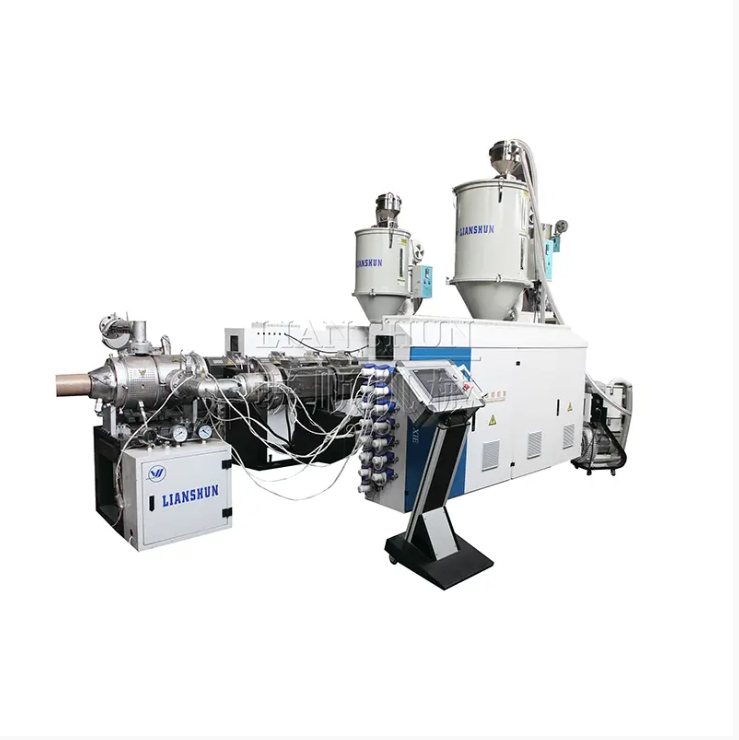
The biggest advantage of a gravimetric dosing system is its ability to monitor material consumption in real time.
Sensors continuously measure the actual weight of materials entering the extrusion process. If the feed rate changes unexpectedly, the system immediately compensates to maintain the target output.
This ensures a stable material flow regardless of changes in raw material density, temperature, or batch characteristics.
Consistent Product Quality
Accurate dosing directly affects product quality.
For example, in a plastic pipe extrusion line, maintaining a consistent material feed helps achieve uniform wall thickness and stable pipe dimensions. In profile extrusion, accurate dosing improves surface quality and dimensional precision.
As production speeds continue to increase, precise dosing becomes even more important for maintaining quality standards.
Supporting Plastic Extrusion Automation
Reduced Human Intervention
One of the key goals of plastic extrusion automation is reducing manual adjustments during production.
Traditional feeding systems often require operators to frequently check output rates and manually correct feeding errors. Gravimetric systems automatically perform these adjustments, reducing operator workload and minimizing human error.
Better Production Data
Modern dosing systems can collect and analyze production data in real time. Manufacturers can track:
- Material consumption
- Production output
- Recipe accuracy
- Line efficiency
This data provides valuable insights for process optimization and quality control.
Companies implementing advanced automation solutions alongside extrusion equipment often achieve higher productivity and more predictable production performance.
Improving Plastic Extrusion Efficiency
Lower Material Waste
Raw materials represent a significant portion of manufacturing costs. Overfeeding or inaccurate dosing can quickly increase production expenses.
A gravimetric system minimizes unnecessary material usage by maintaining exact feeding rates throughout production.
Faster Product Changeovers
Many manufacturers process multiple product specifications on the same line. Gravimetric systems simplify recipe management and allow faster transitions between different materials or product sizes.
Higher Overall Equipment Performance
Accurate feeding improves extruder stability, helping maintain optimal operating conditions and reducing unexpected downtime.
As a result, manufacturers can achieve greater plastic extrusion efficiency, higher output consistency, and lower operating costs.
The Future of Smart Extrusion Production
As Industry 4.0 technologies continue to evolve, intelligent dosing systems are becoming an essential component of modern extrusion lines.
The combination of gravimetric feeding, automated control systems, and real-time production monitoring creates a more efficient and data-driven manufacturing environment.
For manufacturers seeking higher quality standards, reduced waste, and improved productivity, investing in a gravimetric dosing system is no longer just an option—it is becoming a competitive necessity.
Conclusion
A gravimetric dosing system provides far more than accurate material feeding. It strengthens extrusion material control, supports plastic extrusion automation, improves product consistency, and increases overall production efficiency.
As manufacturers face growing pressure to reduce costs while maintaining high-quality standards, gravimetric technology offers a practical and proven solution for achieving long-term success in modern extrusion production.
Post time: Jun-03-2026


