

Introduction
In modern plastic pipe manufacturing, both HDPE and PVC systems are widely used in water supply, drainage, and infrastructure applications. Although both rely on extrusion technology, their production processes differ in material behavior, machine configuration, and long-term operational efficiency. These differences directly impact pipe extrusion efficiency, stability, and overall plastic pipe production cost, especially in large-scale industrial production.
Core Differences in HDPE and PVC Pipe Production
Material Processing Characteristics
HDPE (High-Density Polyethylene) is processed from pellets that melt uniformly, allowing stable and continuous production. This makes it highly suitable for long production runs. In contrast, PVC is a dry-blend material that is more sensitive to heat. If temperature control is not precise, it may degrade or lose quality during processing.
These differences mean that each material requires a different approach in machine design and operation strategy.
Extrusion System Design
A typical HDPE pipe production line uses a single-screw extruder with grooved feeding to ensure high output and stable melting performance. This structure supports continuous, high-efficiency production.
On the other hand, a PVC pipe manufacturing process usually relies on a twin-screw extruder, which provides stronger mixing ability but requires more precise control of temperature and speed.
Pipe Extrusion Efficiency Comparison
Production Stability and Output
When comparing pipe extrusion efficiency, HDPE systems generally perform better in continuous production. The melting process is smoother, and the system is less sensitive to small operational fluctuations. This results in fewer interruptions and higher long-term output.
PVC systems, while slightly slower in production stability, offer excellent dimensional accuracy. However, they require more frequent adjustments, which can affect continuous running efficiency.
Cooling and Sizing Process
In HDPE production, pipes usually require longer cooling sections due to thicker wall applications. Modern vacuum calibration systems help maintain stable diameter and roundness.
PVC pipes cool faster, but the calibration process is more sensitive. Even small pressure or temperature changes can affect final pipe quality, especially in high-speed production lines.
Cost and Energy Analysis
Understanding Plastic Pipe Production Cost
The overall plastic pipe production cost depends on energy consumption, raw material efficiency, maintenance frequency, and operator skill.
HDPE systems typically offer:
⦁Lower maintenance requirements
⦁Reduced scrap rates
⦁More stable long-term operation
PVC systems, however, may require:
⦁Higher precision control systems
⦁More frequent maintenance of screws and barrels
⦁Skilled operators for stable output
These factors influence long-term profitability and production planning.
Energy Efficiency in Production
Energy consumption is another key factor in efficiency comparison. HDPE extrusion lines usually benefit from smoother melting behavior, reducing overall power demand. PVC systems require more precise heating zones, which can increase energy sensitivity depending on production conditions.
Modern optimization technologies, such as improved screw design and cooling systems, continue to enhance both processes.
Which Production Process Is More Efficient?
From a general manufacturing perspective, HDPE systems are often considered more efficient due to their:
Higher continuous output capability
Lower sensitivity to processing conditions
Better long-term operational stability
However, PVC systems remain highly valuable for applications requiring tight dimensional control and cost-effective production of small to medium diameter pipes.
Both systems play important roles in the global plastic pipe industry, and the best choice depends on product requirements and market demand.
Conclusion
HDPE and PVC pipe manufacturing processes each have their own strengths. HDPE systems focus on efficiency and large-scale output, while PVC systems emphasize precision and material control. Choosing the right production line depends on balancing pipe extrusion efficiency, product quality requirements, and overall plastic pipe production cost.
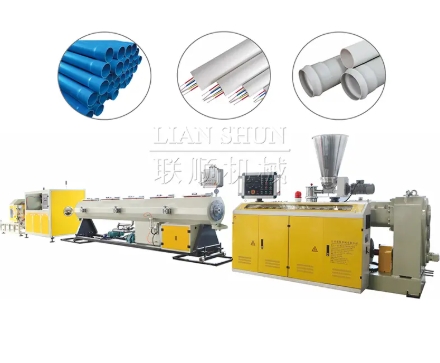
For manufacturers, selecting the proper system is not about which is better overall, but which is better suited for specific applications and long-term production goals.
Post time: Jun-08-2026


